Wisdom tooth extraction is a surgical procedure to remove one or more third molars — the last set of teeth to erupt, typically between ages 17-25. At Tranquil Dental Studio, we perform this common procedure to prevent or treat problems caused by impacted or problematic wisdom teeth.
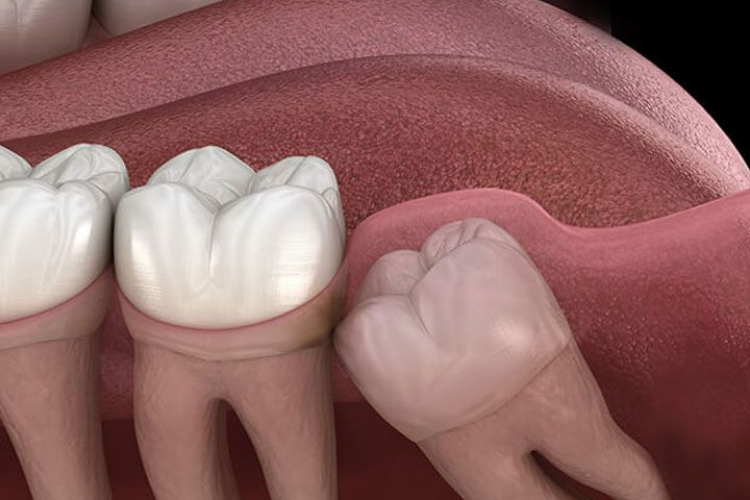
Wisdom teeth often become impacted (trapped in the jawbone or gums), grow in at incorrect angles, or only partially erupt. These issues can lead to pain, infection, crowding, cysts, and damage to adjacent teeth.
At Tranquil Dental Studio, our experienced oral surgeons use state-of-the-art technology and gentle techniques to ensure your comfort before, during, and after the procedure.
Common problems caused by wisdom teeth that we treat at Tranquil Dental Studio
Impacted wisdom teeth often cause persistent pain, swelling, and tenderness in the jaw and surrounding gums.
Partially erupted wisdom teeth create pockets where bacteria accumulate, leading to painful infections (pericoronitis).
Impacted wisdom teeth can push against neighboring molars, causing crowding, root resorption, or decay.
Wisdom teeth can shift existing teeth, undoing the results of orthodontic treatment or causing misalignment.
Fluid-filled cysts can develop around impacted wisdom teeth, potentially damaging the jawbone and nerves.
Wisdom teeth are hard to reach, making them prone to cavities and gum disease.
Understanding how wisdom teeth can be positioned — and how we treat each type at Tranquil Dental Studio
The tooth is upright but trapped beneath the gum. Usually easier to remove with minimal complications.
The most common type — tooth angles toward the front of the mouth, pushing against the second molar.
The tooth angles toward the back of the mouth. Less common but requires specialized surgical technique.
The tooth lies completely sideways, pressing directly against the adjacent molar. This is the most complex type to remove.
A step-by-step guide to your comfortable extraction experience
At Tranquil Dental Studio, we take digital X-rays and 3D CBCT scans to evaluate the position of your wisdom teeth and their relationship to nearby nerves and sinuses.
We offer local anesthesia, nitrous oxide, IV sedation, or general anesthesia to ensure your complete comfort during the procedure.
If the tooth is impacted, a small incision is made in the gum. Some bone may need to be removed to access the tooth.
The wisdom tooth may be divided into smaller sections for easier removal, minimizing trauma to surrounding tissue.
The extraction site is thoroughly cleaned. Sutures (stitches) are placed to promote proper healing.
Our team at Tranquil Dental Studio provides detailed aftercare instructions to ensure a smooth, comfortable recovery.
Why removing problematic wisdom teeth improves your oral health
Removes the source of chronic jaw pain, headaches, and facial discomfort caused by impacted teeth.
Eliminates the risk of recurrent pericoronitis (gum infection around partially erupted wisdom teeth).
Prevents damage, crowding, and decay of healthy neighboring molars.
Prevents wisdom teeth from undoing the results of braces or clear aligner treatment.
Without hard-to-clean wisdom teeth, maintaining good oral hygiene becomes easier and more effective.
Proactive removal prevents more complex issues that may develop with age.
Why early removal is recommended by our experts at Tranquil Dental Studio
This is the ideal window for wisdom tooth removal. The roots are less developed, bone is less dense, and healing is faster.
Even without symptoms, many young adults choose proactive removal to prevent future complications.
Removal is still possible and beneficial, though recovery may take slightly longer due to denser bone.
At Tranquil Dental Studio, we recommend an evaluation by age 16 to assess your wisdom teeth and plan for optimal timing of extraction if needed.
Tips from Tranquil Dental Studio for a smooth, comfortable recovery
Apply ice to the outside of your cheek for 15-20 minutes at a time during the first 24 hours to reduce swelling.
Follow our instructions for pain relievers and antibiotics to manage discomfort and prevent infection.
Stick to cool, soft foods like yogurt, smoothies, soup, applesauce, and mashed potatoes for the first few days.
Don't spit, use straws, or smoke for at least 72 hours to protect the blood clot that forms in the extraction site.
Avoid strenuous activity for 48-72 hours. Keep your head elevated when lying down.
We'll schedule a follow-up visit to monitor healing and remove sutures if needed.
Experience the difference of expert, compassionate surgical care
Our team has performed thousands of successful wisdom tooth extractions with exceptional outcomes.
At Tranquil Dental Studio, we use CBCT technology for precise surgical planning and safety.
Multiple sedation options ensure a pain-free, anxiety-free experience.
We work with most insurance providers and offer flexible financing options.
Schedule your consultation at Tranquil Dental Studio today. Our team will evaluate your wisdom teeth and create a personalized treatment plan.
Everything you need to know about wisdom tooth extraction at Tranquil Dental Studio
During the procedure, you won't feel pain thanks to effective anesthesia and sedation options. Afterward, some discomfort is normal but can be managed with prescribed or over-the-counter pain medication. Most patients report that recovery is less uncomfortable than they expected.
Most patients return to normal activities within 3-5 days. Complete healing of the extraction site takes several weeks. At Tranquil Dental Studio, we'll provide detailed recovery guidelines based on your specific case.
Not always. Some wisdom teeth erupt properly, are fully functional, and can be cleaned easily. At Tranquil Dental Studio, we only recommend extraction when wisdom teeth are causing or likely to cause problems.
The cost varies depending on the complexity (simple vs. impacted). Most dental insurance plans cover a significant portion of wisdom tooth extraction. Our team at Tranquil Dental Studio will provide a detailed estimate and verify your benefits.
If you're receiving IV sedation or general anesthesia, you'll need to fast for 6-8 hours before surgery. For local anesthesia only, you may eat a light meal before your appointment. We'll provide specific instructions during your consultation.
Leaving problematic wisdom teeth can lead to chronic pain, recurrent infections, damage to adjacent teeth, cyst formation, crowding, and even more complex surgical procedures later in life. At Tranquil Dental Studio, we recommend proactive removal when indicated.